




Pharma-Tech Converge 2026: Augmented Intelligence, Transformative Therapies
Written by Mr. Shamsuzzaman Ansari, Associate – Professor
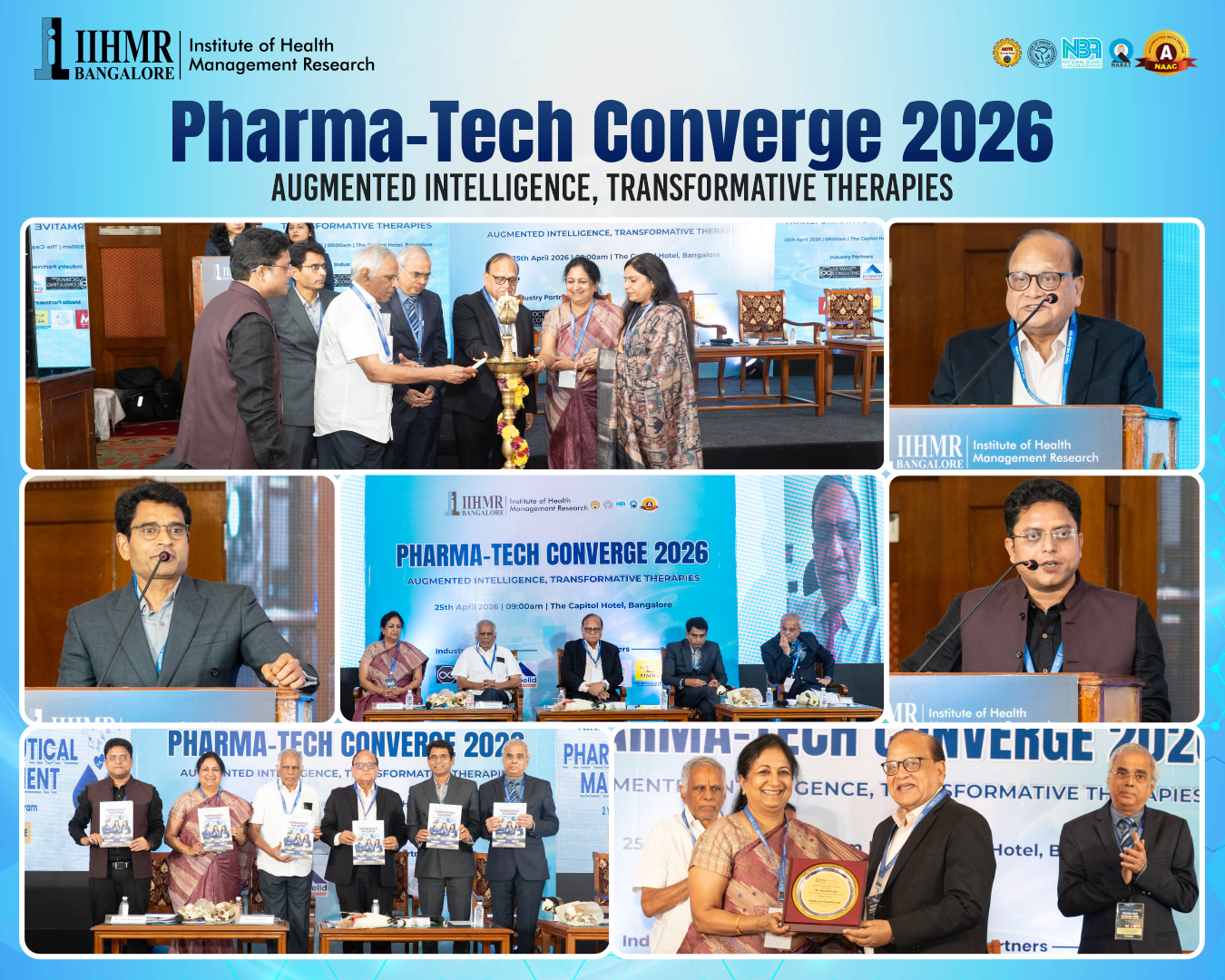
The healthcare and pharmaceutical sectors are undergoing one of the most defining transitions of the century. Artificial intelligence, digital health ecosystems, advanced analytics, biotechnology, and patient-centric innovation are no longer futuristic ideas – they are actively reshaping how healthcare is delivered, researched, and managed. Against this backdrop, the second edition of Pharma-Tech Converge 2026, hosted by Institute of Health Management Research (IIHMR), Bangalore on April 25, 2026, at The Capitol Hotel, emerged as one of the most significant healthcare and pharmaceutical conferences of the year.
Centered around the theme “Augmented Intelligence, Transformative Therapies,” the conclave brought together pharmaceutical leaders, policymakers, academicians, healthcare professionals, researchers, and technology experts to deliberate on the future of healthcare and India’s growing role in global pharmaceutical innovation.
A Gathering of Visionaries and Industry Leaders
The conference was graced by several distinguished dignitaries and thought leaders who collectively represented the convergence of academia, healthcare, technology, and the pharmaceutical industry.
The event featured:
- Mr. Sudarshan Jain, Chairman, IIHMR University; Secretary General, Indian Pharmaceutical Alliance (IPA); Former MD, Abbott Healthcare
- Guest of Honour: Mr. Vikrant Shrotriya, Corporate Vice President & Managing Director, Novo Nordisk
- Dr. S. D. Gupta, President, IIHMR Society, Jaipur
- Prof. S. Sadagopan, Visiting Distinguished Professor, IIHMR Bangalore; Former Director, IIIT Bangalore
- Dr. C. S. Kedar, IAS (Retd.), Senior Advisor, IIHMR Bangalore; Former Director General, ESIC
- Dr. Usha Manjunath, Professor and Director, IIHMR Bangalore
The conclave also witnessed participation from leading organizations including Novo Nordisk, Sandoz, Micro Labs, Biocon, IQVIA, Fortrea, and several others.
Opening the Dialogue: Innovation Through Collaboration
The conference commenced with a formal welcome address by Dr. Usha Manjunath, who emphasized the growing importance of partnerships, innovation, and interdisciplinary collaboration in strengthening the healthcare ecosystem.
Delivering the presidential remarks virtually, Dr. S. D. Gupta highlighted the urgent need for stronger convergence between academia and industry. He stressed that educational curricula must evolve in alignment with industry requirements to create skilled, future-ready professionals capable of thriving in an increasingly technology-driven healthcare environment.
India’s Healthcare Vision Towards Viksit Bharat 2047
One of the most compelling moments of the conference came during the keynote address by Mr. Sudarshan Jain. In a forward-looking and deeply insightful address, he outlined a transformative roadmap for India’s pharmaceutical sector in the journey toward *Viksit Bharat 2047*. He emphasized that India must move beyond being merely a volume-driven generics manufacturer and evolve into a high-value, innovation-led global healthcare powerhouse. His message resonated strongly with the broader industry sentiment that the future belongs not just to scale, but to discovery, innovation, and patient-centric solutions.
Complementing this perspective, Mr. Vikrant Shrotriya stressed the rising demand for hybrid talent – professionals equally comfortable with life sciences, analytics, coding, and digital technologies. He argued that traditional discipline-siloed education models are no longer adequate in an era where healthcare challenges are becoming increasingly complex and chronic in nature. He also encouraged participants to think beyond incremental progress and instead focus on scalable, high-impact solutions enabled by collaboration among academia, industry, and technology ecosystems.
Introducing PGDM in Pharmaceutical Management
One of the landmark moments of the conference was the formal launch of the two-year, full-time, AICTE-approved PGDM in Pharmaceutical Management – a strategic academic initiative aimed at addressing the growing talent gap in India’s rapidly expanding pharmaceutical sector. The programme received AICTE approval in 2026, marking a significant milestone in IIHMR Bangalore’s academic expansion and commitment to industry-oriented education.
“Take a Tablet, Think India”
Adding a memorable and visionary dimension to the discussions, Prof. S. Sadagopan offered a striking analogy: “Just as the world associates software with India, the country must now build a similar identity for pharmaceuticals – ‘Take a tablet, think India. He described Bengaluru as uniquely positioned at the intersection of biotechnology and information technology, making it an ideal innovation hub for the future of global healthcare. His remarks strongly encouraged young professionals to embrace interdisciplinary innovation where biology and technology merge to create transformative healthcare solutions.
The Shift Towards Preventive Healthcare
A major healthcare concern was raised by Dr. C. S. Kedar, who pointed out that nearly 70–80% of patients visiting government hospitals seek treatment for similar and often preventable conditions. He highlighted the alarming rise of lifestyle diseases such as diabetes, hypertension, and depression, even among younger populations in rural India. His address reinforced the need for healthcare systems to move decisively from treatment-oriented approaches toward scalable preventive healthcare models powered by awareness, technology, and early intervention.
Dynamic Panel Discussions Driving Meaningful Conversations
The conference featured three highly engaging panel discussions that explored the evolving pharmaceutical and healthcare landscape from multiple dimensions.
Reimagining Pharma: From Traditional Generics to Transformative Therapies
Moderated by Mr. Anup Soans, the first panel examined how pharmaceutical companies must transition from traditional volume-based business models toward innovation-driven therapies and personalized healthcare solutions. Panelists including leaders from C5i, Graphene AI, and Micro Labs discussed how artificial intelligence and analytics can drive research efficiency, patient outcomes, and strategic decision-making.
India’s GCC Revolution in Pharma
The second panel focused on the evolution of India’s Global Capability Centres (GCCs) from cost arbitrage models to innovation-driven strategic hubs. Moderated by Mr. Vikrant Gill, the discussion brought together leaders from Novo Nordisk, Sandoz, IQVIA, and Octavus Consulting to discuss India’s growing strategic importance in global pharmaceutical operations, analytics, and innovation.
Identifying Future Leaders in Healthcare and Pharma
The third panel explored leadership, talent development, and the changing expectations from future healthcare professionals. Moderated by Mr. K. S. Srinivas, the discussion featured speakers from Ripples Learning, Kauvery Hospital, and IIHMR Bangalore. The panel emphasized that leadership today is defined not merely by technical expertise, but by adaptability, curiosity, emotional intelligence, and the ability to navigate ambiguity.
Technology at the Core of Healthcare Transformation
The conference also featured highly engaging expert talks on emerging technologies shaping the future of healthcare. Ms. Rubal Sabharwal delivered a compelling presentation on technologies that will positively impact the pharmaceutical industry, while Dr. Bhaskar Rajakumar explored the rapidly evolving world of digital health, AI, and smart medical devices.
These discussions reinforced a central message echoed throughout the conference: technology is no longer a support function in healthcare – it is becoming the foundation upon which future healthcare systems will operate.
Key Takeaways from Pharma-Tech Converge 2026
Several powerful themes consistently emerged across the conference sessions:
- AI must serve as a strategic enabler across the pharmaceutical value chain rather than being adopted superficially.
- The industry must shift from volume-based growth toward value-driven healthcare innovation.
- Academia and industry must collaborate more closely to create future-ready talent.
- Hybrid professionals with expertise across biology, analytics, technology, and management will define the next era of healthcare.
- India is uniquely positioned to emerge as a global leader in pharmaceutical innovation and healthcare technology.
- Preventive healthcare and early intervention models are becoming critical public health priorities.
- India’s GCC ecosystem is rapidly evolving into a global innovation engine.
- Leadership development must focus on adaptability, curiosity, judgment, and continuous learning.
- The vision for India should extend beyond “Make in India” toward “Discover in India.”
A Conference That Reflected the Future of Healthcare
Pharma-Tech Converge 2026 was more than just a conference – it was a platform that reflected the changing identity of the healthcare and pharmaceutical sectors. It showcased how the convergence of artificial intelligence, biotechnology, analytics, preventive healthcare, and interdisciplinary collaboration is shaping a new healthcare future. At a time when the world is searching for scalable, technology-enabled, and patient-centric healthcare solutions, the discussions at the conclave strongly reinforced India’s potential to become not only the pharmacy of the world, but also a global innovation powerhouse in healthcare.
As the healthcare ecosystem continues to evolve, one message from the conference stood out clearly: the future belongs to organizations, professionals, and nations that can successfully integrate intelligence, innovation, empathy, and collaboration into healthcare transformation.