


Written by Dr B Pratap Kumar Nair, Professor Institute of Health Management Research (IIHMR), Bangalore, Industry Adviser/Mentor – Obesity, Diabetes and Lifestyle Diseases | Global Plenary Speaker
The history of modern metabolic medicine is closely intertwined with Eli Lilly and Company and Novo Nordisk, whose scientific journeys have repeatedly intersected with major transformations in diabetes and obesity therapy. Their connection with insulin dates to the early 1920s, when insulin transformed diabetes from a frequently fatal disorder into a treatable chronic disease. Insulin production subsequently developed in North America and Denmark, with Lilly playing an important role in scaling manufacturing and the Danish insulin companies eventually becoming Novo Nordisk.¹–⁴
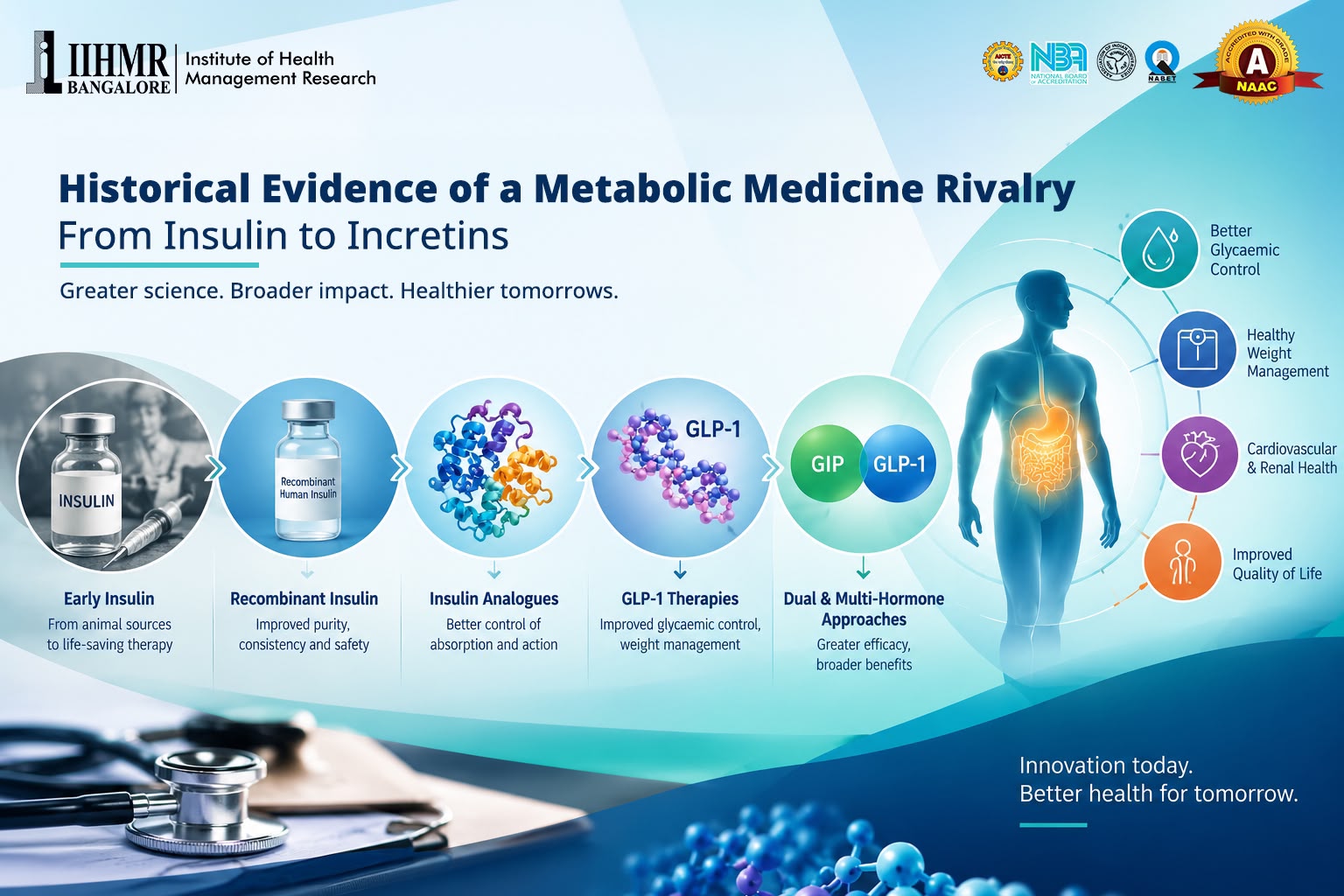
The first generation of insulin was derived principally from bovine and porcine pancreatic tissue. Although revolutionary, animal insulin presented challenges involving supply, purification, consistency and immunogenicity. Recombinant-DNA technology fundamentally changed this landscape. In 1978, scientists associated with Genentech and City of Hope developed recombinant human insulin, which Lilly subsequently commercialized. In 1982, the U.S. Food and Drug Administration approved Humulin, the first biosynthetic human insulin and the first approved medical product produced using recombinant-DNA technology.⁴,⁵
The scientific challenge then shifted from manufacturing human insulin to deliberately engineering its pharmacological properties. Insulin analogues were developed to alter absorption, onset and duration of action. Lilly’s insulin lispro, Humalog, was approved in 1996, marking an important advance in rapid-acting insulin therapy. Subsequent generations of long-acting and ultra-long-acting insulin progressively improved pharmacokinetic control.⁶
A further milestone emerged with once-weekly basal insulin. Novo Nordisk’s insulin icodec, marketed as Awiqli, became the first once-weekly basal insulin approved by the FDA in March 2026 for adults with type 2 diabetes. Lilly subsequently received FDA approval in September 2026 for insulin efsitora alfa, marketed as Onswik, another once-weekly basal insulin.⁷,⁸ Thus, insulin therapy evolved from animal extraction to recombinant human insulin, molecularly engineered analogues and, ultimately, weekly administration.
The therapeutic revolution then moved beyond insulin replacement. Increasing understanding of incretin physiology revealed the importance of glucagon-like peptide-1 (GLP-1), which enhances glucose-dependent insulin secretion, suppresses inappropriate glucagon secretion, slows gastric emptying and promotes satiety.¹ This shifted the central therapeutic question from correcting insulin deficiency to modifying broader metabolic signalling.
Novo Nordisk became a major force in the GLP-1 era through semaglutide. Once-weekly semaglutide demonstrated substantial improvements in glycaemic control and body weight and subsequently became an important therapy for obesity. The distinction between Ozempic for type 2 diabetes and Wegovy for chronic weight management illustrated a fundamental change: obesity was increasingly recognized as a chronic metabolic disease requiring long-term pharmacological management.⁹
Lilly pursued a different approach by combining complementary incretin pathways. Tirzepatide is a dual GIP and GLP-1 receptor agonist. In clinical trials, it produced greater reductions in glycated haemoglobin and body weight than semaglutide 1 mg in people with type 2 diabetes, while subsequent obesity trials demonstrated substantial weight reduction in individuals without diabetes.¹⁰,¹¹ The therapeutic paradigm consequently expanded from GLP-1 receptor agonism to dual incretin pharmacology.
The next frontier is multi-hormonal therapy. Lilly’s investigational retatrutide activates GIP, GLP-1 and glucagon receptors. In phase 2 research, the highest dose produced approximately 24% mean weight reduction at 48 weeks. In 2026, Lilly reported positive topline phase 3 TRIUMPH-1 results, including approximately 28.3% mean weight reduction at 80 weeks with the 12-mg dose.¹²,¹³ These topline findings remain company-reported and require interpretation alongside eventual peer-reviewed publication. Retatrutide remained investigational as of September 2026.
Novo Nordisk has pursued another multi-pathway strategy through CagriSema, combining semaglutide with the long-acting amylin analogue cagrilintide. Rather than triple-receptor agonism, CagriSema combines GLP-1 and amylin biology. Phase 3 studies have demonstrated substantial weight reduction, and the combination entered U.S. regulatory review for weight management.¹⁴–¹⁶
These developments illustrate the transformation from traditional diabetes pharmacotherapy, primarily focused on glucose lowering, toward broader metabolic medicine encompassing glycaemic control, appetite, satiety, body weight, energy balance, cardiovascular and renal risk, treatment adherence and long-term disease burden. The competition between Lilly and Novo Nordisk therefore represents more than a conventional pharmaceutical rivalry. Their strategies demonstrate two different routes toward the same therapeutic frontier: increasingly sophisticated manipulation of human metabolic physiology.
The century-long progression can be viewed as a continuous scientific evolution: animal insulin to recombinant human insulin; human insulin to engineered analogues; daily insulin to ultra-long-acting and once-weekly insulin; insulin replacement to GLP-1-mediated metabolic regulation; GLP-1 therapy to GIP/GLP-1 dual agonism; and finally toward triple hormonal agonism and GLP-1/amylin combinations.
The future competitive landscape will extend beyond headline weight loss. Durability, glycaemic efficacy, cardiovascular and renal outcomes, safety, tolerability, dosing convenience, oral delivery, adherence, manufacturing capacity, affordability and global access will increasingly determine the clinical and societal impact of metabolic therapies. The central scientific question has therefore changed dramatically. A century ago, the challenge was, “How can insulin be replaced?” Today, the frontier is increasingly, “How can human metabolism be therapeutically engineered?” The continuing scientific divergence and convergence of Lilly and Novo Nordisk provides a remarkable illustration of how molecular biology, endocrinology, biotechnology and clinical medicine can progressively redefine an entire therapeutic field.
References
- Rosen CJ, Ingelfinger JR. GLP-1 receptor agonists. N Engl J Med. 2026;394:1313-1324. doi:10.1056/NEJMra2500106.
- Nobel Prize. The discovery of insulin. Nobel Prize scientific and historical records.
- Novo Nordisk. Our heritage: more than a century of insulin and metabolic disease innovation.
- U.S. Food and Drug Administration. 100 Years of Insulin. FDA History Exhibits.
- U.S. Food and Drug Administration. Humulin: original approval and recombinant human insulin history.
- U.S. Food and Drug Administration. Purple Book: Humalog (insulin lispro). Original approval date June 14, 1996.
- U.S. Food and Drug Administration. Novel Drug Approvals for 2026: Awiqli (insulin icodec-abae). March 26, 2026.
- U.S. Food and Drug Administration. Notable Approvals: Onswik (insulin efsitora alfa-gobe). September 23, 2026.
- Wilding JPH, Batterham RL, Calanna S, et al. Once-weekly semaglutide in adults with overweight or obesity. N Engl J Med. 2021;384:989-1002. doi:10.1056/NEJMoa2032183.
- Frías JP, Davies MJ, Rosenstock J, et al. Tirzepatide versus semaglutide once weekly in patients with type 2 diabetes. N Engl J Med. 2021;385:503-515. doi:10.1056/NEJMoa2107519.
- Jastreboff AM, Aronne LJ, Ahmad NN, et al. Tirzepatide once weekly for the treatment of obesity. N Engl J Med. 2022;387:205-216. doi:10.1056/NEJMoa2206038.
- Jastreboff AM, Kaplan LM, Frías JP, et al. Triple-hormone-receptor agonist retatrutide for obesity—a phase 2 trial. N Engl J Med. 2023;389:514-526. doi:10.1056/NEJMoa2301972.
- Eli Lilly and Company. Lilly’s triple agonist retatrutide: TRIUMPH-1 phase 3 topline results. May 21, 2026.
- Novo Nordisk. CagriSema development and regulatory update. 2026.
- Garvey WT, Blüher M, Osorto Contreras CK, et al. Coadministered cagrilintide and semaglutide in adults with overweight or obesity. N Engl J Med. 2025;393:635-647. doi:10.1056/NEJMoa2502081.
- Davies MJ, Bajaj HS, Broholm C, et al. Cagrilintide-semaglutide in adults with overweight or obesity and type 2 diabetes. N Engl J Med. 2025;393:648-659. doi:10.1056/NEJMoa2502082.