




Written by Dr B Pratap Kumar Nair, Professor Institute of Health Management Research (IIHMR), Bangalore,
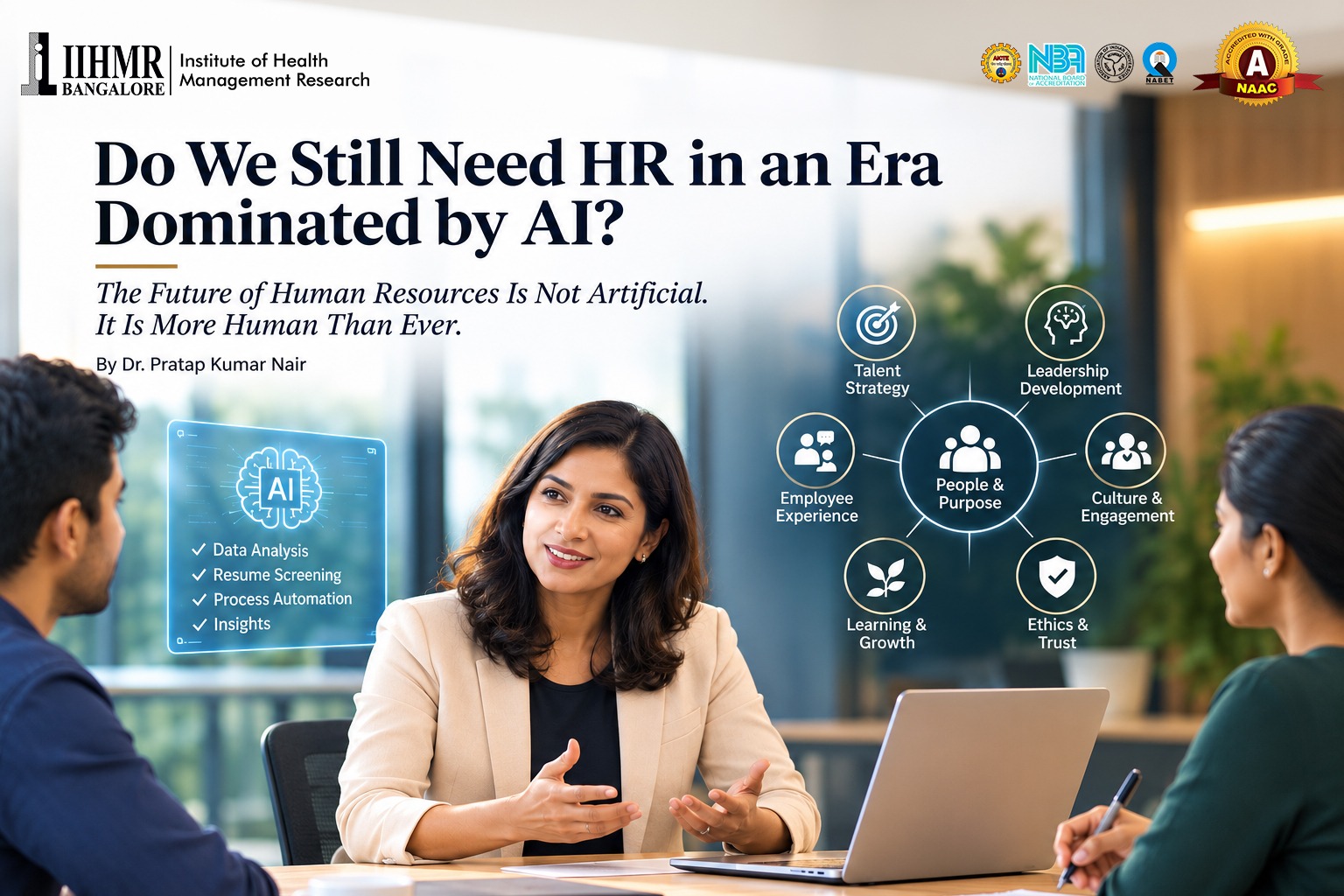
Artificial Intelligence can automate recruitment, analyse employee data and streamline workforce management. But can it build trust, resolve human conflict, develop future leaders and create a culture in which people genuinely want to work? The future of HR will depend on answering that question.
The HR Paradox: More Technology, Greater Need for Humanity
Artificial Intelligence (AI) is challenging one of the most established functions of corporate management: Human Resources.
Recruitment platforms can screen applications, AI-powered systems can analyse employee engagement, and automated assistants can respond to routine policy queries. Emerging AI applications are also changing how organisations manage talent, allocate work and develop employee capabilities.
Naturally, a fundamental question arises: If AI can perform so many HR activities faster and potentially at a lower cost, do organisations still need HR professionals?
The answer is yes—but not necessarily the HR function that organisations have traditionally known.
The administrative HR professional, whose responsibilities revolve primarily around documentation, recruitment coordination, routine employee queries and transactional processes, faces a future of significant transformation.
However, the strategic HR professional, who understands people, organisational behaviour, leadership, business performance and workplace culture, could become even more valuable.
The distinction is crucial. AI may automate HR activities, but automating activities is not the same as replacing the organisational purpose of HR.
The World Economic Forum’s Future of Jobs Report 2025 estimates that 39% of workers’ existing skill sets will be transformed or become outdated between 2025 and 2030. The report also identifies analytical thinking, resilience, flexibility and leadership among the capabilities employers continue to value.¹
The International Labour Organization’s 2025 research similarly concludes that job transformation is generally more likely than complete job elimination as generative AI changes the world of work.²
The message for business leaders is clear: The future of work requires the transformation of HR, not the abandonment of its purpose.
1. What AI Can Do Better Than Traditional HR
Organisations should not defend administrative processes simply because they have historically belonged to HR. Where AI can perform a task reliably, efficiently and responsibly, automation deserves serious consideration.
Consider five areas.
Recruitment and talent acquisition: AI can help identify potential candidates, match qualifications against job requirements, schedule interviews and support applicant communication.
HR operations: Employee queries, leave-policy explanations, document generation and routine onboarding activities can increasingly be handled through automated systems.
Workforce analytics: AI can analyse workforce trends, identify emerging skills gaps, support attrition analysis and help managers interpret organisational patterns.
Learning and development: Personalised learning recommendations can help employees identify relevant skills, courses and career pathways.
Performance support: AI can assist with goal tracking, feedback summaries and performance-data analysis, provided appropriate safeguards are in place.
These capabilities can release HR professionals from repetitive tasks and give them more time for activities requiring judgement, relationship-building and strategic thinking.
However, technological capability should not be confused with organisational readiness. The World Economic Forum reports that 63% of employers surveyed identify skills gaps as a major barrier to business transformation.¹
The implication is significant: businesses cannot become future-ready simply by acquiring new technology. They must also prepare their people to use it effectively.
2. What AI Cannot Replace: The Human Architecture of Business
Organisations are not merely collections of processes, policies and performance indicators. They are communities of people with different motivations, aspirations, personalities and expectations.
This is where the future of HR becomes strategically important.
Emotional Intelligence and Conflict Resolution
An employee’s declining performance may reflect inadequate training, an unsupportive manager, personal difficulties or a genuine mismatch between the individual and the role.
AI may identify patterns in performance data, but interpreting the circumstances requires context, sensitivity and professional judgement.
A dashboard can identify a problem. It cannot, by itself, determine the most appropriate and humane way to resolve it.
Leadership Development
Identifying a high-performing employee is not the same as recognising a future leader.
Leadership involves influencing others, exercising judgement under uncertainty, accepting responsibility and making difficult decisions.
HR must help organisations identify and develop these capabilities rather than rely exclusively on algorithmic rankings. The World Economic Forum’s research highlights leadership and social influence among the skills employers consider important in a changing labour market.¹
Organisational Culture
A corporate culture is created through everyday behaviour: how managers treat employees, how mistakes are handled, whether dissent is encouraged and whether stated organisational values match actual conduct.
AI can help measure indicators of culture. However, organisational leaders remain responsible for creating an ethical, inclusive and psychologically safe workplace.
Trust and Employee Relations
Employees may accept an automated answer to a routine policy question. They are less likely to consider an algorithm an adequate substitute for a thoughtful conversation about workplace harassment, discrimination, career uncertainty or an unfair managerial decision.
HR must provide credible channels for listening, investigation, explanation and resolution.
The International Labour Organization’s research on generative AI and jobs highlights the importance of understanding how technological exposure affects workers and employment conditions.²
The principle is simple: AI can inform a human decision, but it should not automatically become the final authority over a person’s professional future.
3. The New HR: From Human Resources to Human Architecture
The next generation of HR must move beyond its traditional identity as a support function.
It must become an architect of organisational capability.
This transformation involves four priorities.
First, workforce transformation. HR must anticipate which activities will disappear, which roles will change and which new capabilities the business will require. Workforce planning should focus not only on job titles but also on the tasks, skills and responsibilities that create value.
Second, continuous reskilling. As AI changes the nature of work, employees need opportunities to learn, adapt and move into emerging roles. HR must make reskilling an ongoing organisational responsibility rather than an occasional training initiative. The World Economic Forum identifies workforce upskilling as a major employer priority in response to changing technology and skill requirements.¹
Third, human–AI collaboration. HR must help determine which decisions can be automated, which require human review and where accountability must remain explicit.
Fourth, ethical governance. Recruitment, performance assessment, promotion and workforce restructuring can have significant consequences. HR must work with legal, technology and business teams to establish safeguards, transparency, privacy protections and mechanisms for challenging consequential decisions.
The National Institute of Standards and Technology’s Artificial Intelligence Risk Management Framework provides a practical foundation for identifying, assessing and managing AI risks while promoting trustworthy and responsible AI development and use.³
In this environment, HR is no longer merely managing employees. It is helping organisations determine how humans and intelligent systems should work together.
4. The Business Case: Why the Future of HR Matters to the CEO
The future of HR is not simply an internal departmental concern. It is a boardroom issue.
Organisations investing in AI without preparing their people may discover that technological capability does not automatically translate into business performance.
Employees may resist unfamiliar systems. Managers may lack the skills to lead AI-enabled teams. Valuable institutional knowledge may disappear when experienced employees leave. Poorly governed algorithms may undermine confidence in recruitment and performance decisions.
These are problems that technology investment alone cannot resolve.
The World Economic Forum identifies skills gaps as a significant obstacle to business transformation and reports that employers expect to prioritise workforce upskilling in response to changing skill requirements.¹
CEOs should therefore evaluate HR using more meaningful measures than administrative cost and processing speed.
Relevant measures include:
- Workforce productivity and business contribution.
- Availability of critical skills.
- Internal mobility and employee development.
- Leadership readiness and succession planning.
- Quality of recruitment and employee retention.
- Effectiveness of AI adoption.
- Employee trust and organisational culture.
The objective is not to preserve every existing HR role. It is to ensure that the organisation has the human capabilities required to achieve its business strategy.
5. The Danger of Making HR Entirely Algorithmic
There is a temptation to believe that data-driven decisions are necessarily objective.
They are not.
AI systems learn from data, and historical data can reflect existing inequalities, inconsistent managerial judgements and patterns of exclusion. If such patterns enter an algorithmic system without appropriate safeguards, automation can reproduce or amplify them.
An apparently efficient recruitment system could disadvantage qualified candidates. An employee-monitoring platform could undermine trust. A performance model could reward measurable outputs while overlooking mentoring, collaboration and other contributions.
These concerns make AI governance an essential management responsibility.
The National Institute of Standards and Technology’s AI Risk Management Framework emphasises the importance of identifying, assessing and managing risks associated with AI systems. Its guidance can help organisations establish systematic approaches to trustworthy AI.³
Before deploying AI in consequential HR decisions, organisations should ask three questions:
- Is the system sufficiently reliable and appropriate for the decision being made?
- Can the organisation explain and challenge the outcome?
- Is a suitably authorised human accountable for the decision and its consequences?
These questions are particularly important when decisions affect employment opportunities, remuneration, promotion or termination.
Responsible AI in HR requires more than technical accuracy. It requires governance, accountability and respect for the people affected.
6. The HR Professional of 2030: A Different Breed of Leader
The HR professional of the future will need a combination of capabilities that traditional HR education and career development have not always prioritised.
Technology literacy will be essential. So will data interpretation, business strategy, organisational psychology, communication, ethical reasoning and change management.
Future HR leaders must understand how AI works without necessarily becoming AI engineers. They must translate business objectives into workforce capabilities, help managers navigate uncertainty and ensure that technological change strengthens rather than weakens organisational trust.
The World Economic Forum’s research highlights the continuing importance of analytical thinking, resilience, flexibility and leadership alongside growing demand for AI and technological literacy.¹
This combination of technological and human capabilities will define the next generation of effective HR leadership.
Future HR leaders must increasingly ask difficult questions:
Are we automating the right activities? Are we developing the skills our business will need? Are managers equipped to lead AI-enabled teams? Are our systems fair? And are we measuring human contribution in ways that genuinely reflect business value?
These are strategic questions, not administrative ones.
The HR function that answers them effectively will earn a place at the highest levels of corporate decision-making.
Conclusion: AI May Change HR, but It Cannot Eliminate the Need for It
The real debate is not whether organisations need HR in an AI-dominated era.
It is whether they can afford to retain an HR model designed primarily for an administrative world.
AI will automate many activities, reshape jobs and challenge conventional approaches to workforce management. Organisations that ignore these changes risk losing efficiency and competitiveness.
However, organizations that treat people as interchangeable inputs into an automated system risk something equally important: trust, institutional knowledge, leadership capability and the human commitment on which sustainable performance depends.
Research from the World Economic Forum and the International Labour Organization indicates that technological change will significantly affect jobs, skills and workforce requirements.¹˒²
The future belongs to organisations that combine the analytical power of AI with human judgement, empathy, creativity and accountability.
HR must lead that transition, not by competing with AI, but by ensuring that AI serves the organization’s people and purpose.
The ultimate measure of successful HR in the AI era will not be how much human involvement it eliminates. It will be how effectively it uses technology to build a more capable, ethical and productive human workforce.
The administrative HR function may be approaching the end of its traditional form. The strategic HR function, however, is only beginning its most important chapter.
References
1. World Economic Forum. (2025).The Future of Jobs Report 2025. Geneva: World Economic Forum.
https://www.weforum.org/publications/the-future-of-jobs-report-2025/
2. International Labour Organization. (2025).Generative AI and Jobs: A 2025 Update. Research Brief. Geneva: International Labour Organization.
https://www.ilo.org/publications/generative-ai-and-jobs-2025-update
3. Tabassi, E. (2023).Artificial Intelligence Risk Management Framework (AI RMF 1.0). NIST AI 100-1. Gaithersburg, Maryland: National Institute of Standards and Technology.
https://doi.org/10.6028/NIST.AI.100-1